Do nothing
- What it delivers
- Only local capital, which keeps growing.
- Cost to the manager
- It has no cost.
- Brings investors?
- It brings no investors.
- The limit
- The base stays local and dependent on the same distributors.
For managers
The detail of what the managers page sums up: who enters the fund, who is responsible for what, how the investor arrives and how the money moves.
Altstreet's securitisation company is the fund's only quota holder, on behalf of all international investors.
Investors abroad
Many investors, many countries
Altstreet's securitisation company
Brazilian company of the Altstreet group
Register of quota holders
Behind it stand the investors from abroad.
It enters the fund as a professional investor.
The securitisation company already exists: it is a Brazilian securitisation company, and the same company runs an investment platform registered with CVM (CVM Resolution 88).
The rows are illustrative categories of quota holder.
Describes the current design, still without a legal opinion.
What they already do, for one single Brazilian quota holder
From the first reading of the fund to the exit, from the manager's point of view.
42 steps, 12 institutions
For fund quotas, a legal entity stays on the ordinary route, with a representative and CVM registration (Joint Resolution 13, article 14, sole paragraph).
Distinct roles. In practice one institution can combine legal representation, tax representation, custody and brokerage.
Steps taken once, before the first subscription is accepted.
The entity's CNPJ registration
The CNPJ registration follows the CVM registration. Requesting it at the Receita is prohibited. There is one per representative institution.
Onboarding and due diligence at each institution
Each institution with a direct relationship runs onboarding and anti-money-laundering checks, with internal policy setting the documents.
Self-certify tax residence
Declare to the institution the tax residence and tax identification number. A passive entity also names its controlling persons.
Steps repeated at each subscription to a fund's quotas.
Check suitability
The distributor checks the profile or applies the waiver that, on a reading of the rules, covers the non-resident.
Periodic duties and events that occur while the investor holds the quotas.
File the reports with the CVM
The representative files the monthly report within 10 business days and the half-yearly report within 15 business days.
Provide data per final account holder
Registrar, custodian and depositary give the Central Bank and the CVM, on request, the data per final account holder.
Report transfers between non-residents
Mergers, spin-offs, succession and operations that do not change the final holders go to the CVM in the monthly report.
Send notices, confirmations and statements
Under account and order, the distributor gives notice of meetings, issues investment confirmations and sends a monthly statement.
Monitor activity and report to COAF
Each institution monitors activity, reports to COAF within 24 hours of the analysis and files an annual nil declaration.
Classify the quota holder in fund reports
The administrator counts the non-resident quota holder in its own category of the FIDC, FII, FIAGRO and FIP reports.
Update the e-BEF
Update the declaration within 30 days of a change of beneficial owner and, absent a change, by year end.
Redemption, amortisation, sale of quotas, remittance abroad and end of the representation.
32 steps, 12 institutions
For securities, an individual is exempt from a representative and from CVM registration (Joint Resolution 13, article 16, item I), but needs a CPF and registration through B3.
Steps taken once, before the first subscription is accepted.
Onboarding and due diligence at each institution
Each institution with a direct relationship runs onboarding and anti-money-laundering checks, with internal policy setting the documents.
Self-certify tax residence
Declare to the institution the tax residence and tax identification number. A passive entity also names its controlling persons.
Steps repeated at each subscription to a fund's quotas.
Check suitability
The distributor checks the profile or applies the waiver that, on a reading of the rules, covers the non-resident.
Periodic duties and events that occur while the investor holds the quotas.
Provide data per final account holder
Registrar, custodian and depositary give the Central Bank and the CVM, on request, the data per final account holder.
Send notices, confirmations and statements
Under account and order, the distributor gives notice of meetings, issues investment confirmations and sends a monthly statement.
Monitor activity and report to COAF
Each institution monitors activity, reports to COAF within 24 hours of the analysis and files an annual nil declaration.
Classify the quota holder in fund reports
The administrator counts the non-resident quota holder in its own category of the FIDC, FII, FIAGRO and FIP reports.
Redemption, amortisation, sale of quotas, remittance abroad and end of the representation.
Registration of the investment with the Central Bank
The RDE-Portfólio registration was ended by Joint Resolution 13, in force since 1 January 2025.[323]
Mandatory simultaneous exchange
Converting holdings between regimes no longer requires simultaneous exchange operations.[23]
Custodian engaged before the investment
Engaging a specific custodian beforehand is no longer required. CVM Resolution 13 still asks for the contract.[356]
Representative for an individual
An individual no longer needs a representative in the cases of article 16 of Joint Resolution 13.[35]
Today there are 137 non-resident quota holders across 4,389 FIDCs.[24]
3 steps
01Connect a wallet
Connect the wallet in which the investor will hold the token.
02Declare eligibility and pass identification
Declare eligibility and pass the identification carried out by Altstreet.
03Deposit digital dollars
Deposit digital dollars to subscribe.
The other steps stay with Altstreet.
Altstreet does
In six steps, the fund takes part only in the last one.
Investor
Connects the wallet and contributes USDC. Before that, declares not to be from the United States or from Brazil.
Contract
The fund's vault, or the order desk, holds the contribution. The investor can cancel until it closes.
Offshore vehicle
Altstreet's vehicle receives the money and issues the token that tracks the position in the fund.
Exchange
An authorised provider converts the digital dollars into reais.
Altstreet's securitisation company
Buys the quotas from the fund's distributor.
Fund
Receives the reais of the subscription.
Term, in an open fund
An order placed by 2 pm São Paulo time is executed by 6 pm of the second banking day. If the purchase does not go through, the money returns to the investor.
What the investor holds
A token of the offshore vehicle, which tracks the position in the fund. The investor is not a direct quota holder, and at launch the token cannot be transferred. Exit follows the fund's redemption rules.
Who may not invest
The United States and its territories, Brazil and sanctioned countries are excluded, and every wallet is checked against restricted lists.
This is the design of the structure: the contracts are built and tested, and the audit and the legal opinion are pending, with no date promised.
The manager keeps managing the fund, and Altstreet takes care of presenting it and of receiving the contributions.
Every fund in operation already has a page in English and Portuguese, built from CVM data: what the fund buys, history, service providers, documents.
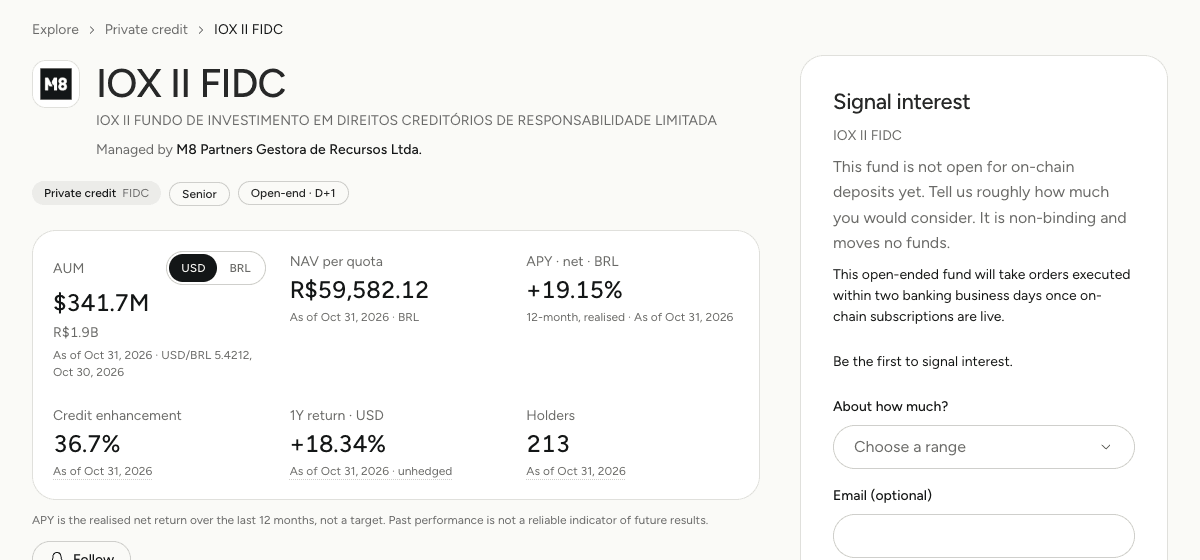
8,251 funds and 572,101 documents in the catalog. Sponsorship does not change the thesis or the ranking, and paid content is labelled.[25]
The investor contributes USDC from a wallet and Altstreet's securitisation company buys the quotas in reais.
Contracts built and tested. The manager needs no offshore vehicle of its own.
A smaller fixed part and a variable part, charged only on new money.
The amounts are agreed in a conversation.
It covers your fund's page and the shared structure, and costs less than building an offshore vehicle of your own.
It applies only to the money Altstreet brings to the fund. If nothing arrives through us, there is nothing variable to pay, and capital that would have come anyway stays out of the count.
You share only what arrives through our channel.
We do not ask for exclusivity: Altstreet adds a channel to the distributors you already have.
We do not publish a price list.
The listing is only worth paying for if investors can trust it. These rules apply to every fund, sponsor or not.
Sponsorship never changes a fund's data, its thesis text or any ranking.
Rankings follow published rules.
Everything paid is labelled.
We compare seven routes by category. Only Altstreet combines the introduction to the investor with the rail to receive him.
| Route | Do nothing | The foreign investor comes directly | Your own offshore vehicle | Altstreet |
|---|---|---|---|---|
| What it delivers | Only local capital, which keeps growing. | The quota in the investor's own name. | A mirror fund outside the country. | A showcase in English and an on-chain rail with a shared structure. |
| Cost to the manager | It has no cost. | It has a low cost. | It has a high, fixed and recurring cost. | It has a small fixed part and a variable part on new capital. |
| Brings investors? | It brings no investors. | It brings no investors. | It brings no investors. | It brings investors, with no promise of volume. |
| The limit | The base stays local and dependent on the same distributors. | Only large investors can bear registration, a representative and exchange. | It needs one vehicle per strategy and takes months. | The rail is in pre-launch, and the investor needs a wallet. |
Compared by category, with no company names, and it does not replace your own analysis. If you already have a private-bank investor in the queue, the ISIN note is the right product and Altstreet comes in as a second channel.